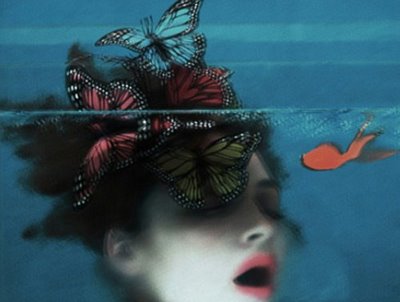
I was not a huge fan of the lecture today for Kathy Rose. I found it odd that she barley spoke about her work during the lecture, and did not mention concept or much about inspiration. her work has definatley evolved with the changing technology due to her early work dealing with hand drawn animation and her later work being extremely digital. I feel overall I would describe her work as vibrant, moving, and intentional. Due to the performance aspect being such an important part of her animations, she must make sure that everything is planned out. Like I had wondered before the lecture, she does plan out each part of the performance, but whether the movement or the animation comes first, all depends on the project, and changes constantly.
Her earlier work I found the most interesting due to the mixture of animation and dance, and the polished look due to the cohesiveness of the two. I did not know that she had dance experience which obviously inspired her work in the 80's. I feel the fact that she merged two art forms into one performance made her work very interesting. I find this body of work to be the most compelling because everything has to be planned out, yet the performance looks like an improvisation, due to her movements.
Rose's most recent work I was not as impressed with as her early work. I found it seemed too digital and the overall effect did not have the finessing that her earlier work did. The videos were awkward and became boring to watch. I also did not like many of the special effects because they did not seem to work well and the technical downfalls overshadowed the overall work. I wonder why she has not considered going back to less computerized approaches since those worked much better with her vision.
Thursday, March 3, 2011

Sunday, February 27, 2011
Katy Rose Questions
1. When creating what you will project, do you think about how it will interact with the live subject, or do you plan out the placement of the subject after?
2. Your current work is very different from your earlier work in the 70s and 80s. Does this have a lot to do with better technology being available?
2. Your current work is very different from your earlier work in the 70s and 80s. Does this have a lot to do with better technology being available?
Thomas Hager
I love Hager's series Catharsis due to the motion or the subjects and the mood of the images. I find I connect to the concept of this work, through seeing how the subjects are struggling with outside forces effecting them. This is like my series in which it deals with how one thing can create a completely different world for the subject, wether it is bad or good.
Biography:
Thomas Hager is a fine art photographer who received his BFA from the University of North Florida and currently lives in Florida. His work has an antique affect to them which he says gives his images a "painterly" effect. His work revolves around studying the organic forms such as flowers, shells, the human body, and much more. His work is extremely popular in corporate settings due to the subject matter he chooses.
Quotes:
"The process enhances the dimensional quality of the image due to the chemicals’ ability to get into the fibers of the paper rather than staying on top of the paper as with traditional photographic paper. This creates a soft, tactile surface which is congruous with nature. " - Thomas Hager
"My investigation of this vintage process has not only increased my life long exploration of the medium of photography but has helped make a profound statement for my subject matter. " - Thomas Hager


Biography:
Thomas Hager is a fine art photographer who received his BFA from the University of North Florida and currently lives in Florida. His work has an antique affect to them which he says gives his images a "painterly" effect. His work revolves around studying the organic forms such as flowers, shells, the human body, and much more. His work is extremely popular in corporate settings due to the subject matter he chooses.
Quotes:
"The process enhances the dimensional quality of the image due to the chemicals’ ability to get into the fibers of the paper rather than staying on top of the paper as with traditional photographic paper. This creates a soft, tactile surface which is congruous with nature. " - Thomas Hager
"My investigation of this vintage process has not only increased my life long exploration of the medium of photography but has helped make a profound statement for my subject matter. " - Thomas Hager


Screen Shots from his website


Friday, February 25, 2011
POV
Point of view will play an important role in my narrative now that I am interested in having first person and third person perspective. It is important to study the writer's view of how to appropriately change point of view. What will make this work is by using proper editing to make sure the view is not confused.
"Writing a Multiple Viewpoint Novel - Novel Writing Help." Expert Novel Writing Help and Advice. Web. 25 Feb. 2011. <http://www.novel-writing-help.com/multiple-viewpoint-novel.html>.
This article was a great beginners course on the different perspectives one can use in narratives. It explained different ways in which one could incorporate multiple points of view on a story line. The article gave advice on how to effectively switch the view points with in the story.
Quotes:
"But in most multiple viewpoint novels, you have the novel's protagonist, who gets to be the viewpoint character in most of the chapters (not least the opening and closing ones), with the remaining chapters being told by one or more of the lesser characters."
"Let's start with the basics: a multiple viewpoint novel is one in which two or more members of your cast list are viewpoint characters - that is, those characters through whose eyes we witness the events of the novel and whose thoughts and feelings we have direct access to."

"Writing a Multiple Viewpoint Novel - Novel Writing Help." Expert Novel Writing Help and Advice. Web. 25 Feb. 2011. <http://www.novel-writing-help.com/multiple-viewpoint-novel.html>.
This article was a great beginners course on the different perspectives one can use in narratives. It explained different ways in which one could incorporate multiple points of view on a story line. The article gave advice on how to effectively switch the view points with in the story.
Quotes:
"But in most multiple viewpoint novels, you have the novel's protagonist, who gets to be the viewpoint character in most of the chapters (not least the opening and closing ones), with the remaining chapters being told by one or more of the lesser characters."
"Let's start with the basics: a multiple viewpoint novel is one in which two or more members of your cast list are viewpoint characters - that is, those characters through whose eyes we witness the events of the novel and whose thoughts and feelings we have direct access to."

Tuesday, February 22, 2011
Sarah Jones
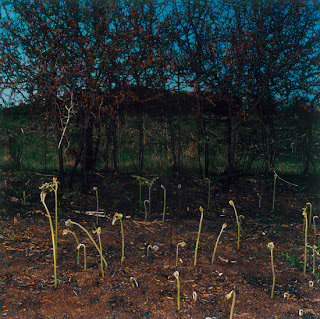
Sara Jones work is conceptually similar to mine. She deals with creating unnatural scene from the natural and creating surreal photographs in very familiar settings. I am interested in how our images are visually different despite dealing with similar concepts. Though her images have a flat look to them, they transmit a plethora of emotions and interpretations. I also enjoy how the subjects are placed within the photograph, becoming part of the background despite being the largest subject.
Biography:
"Sarah Jones was born in London in 1959 where she continues to live and work. She studied Fine Art at Goldsmith's College, completing her Master's (Distinction) in 1981 and her first degree, in Fine Art and Contemporary Dance, in 1996."- Royal College of Art (http://www.rca.ac.uk/Default.aspx?ContentID=503338)
Quotes:
"This image was part of a series of teenage girls with whom Jones has been working for some time, photographing them in and around their comfortable middle-class homes. The girls inhabit an in-between space that bridges childhood and maturity. In pointing to a haunting narrative beyond the frame--a childhood "uncanny" -- Jones denies her work the genre-portrait status to which it might otherwise be consigned."- Junk for Code (Review link)
"What is explored is the ‘analytic frame’ that marks off the different kind of reality that is within it from that which is outside it; but a temporal spatial frame also marks off the special kind of reality of a psychoanalytic session. "- Junk for Code (Review link)
Gallery
Review


Biography:
"Sarah Jones was born in London in 1959 where she continues to live and work. She studied Fine Art at Goldsmith's College, completing her Master's (Distinction) in 1981 and her first degree, in Fine Art and Contemporary Dance, in 1996."- Royal College of Art (http://www.rca.ac.uk/Default.aspx?ContentID=503338)
Quotes:
"This image was part of a series of teenage girls with whom Jones has been working for some time, photographing them in and around their comfortable middle-class homes. The girls inhabit an in-between space that bridges childhood and maturity. In pointing to a haunting narrative beyond the frame--a childhood "uncanny" -- Jones denies her work the genre-portrait status to which it might otherwise be consigned."- Junk for Code (Review link)
"What is explored is the ‘analytic frame’ that marks off the different kind of reality that is within it from that which is outside it; but a temporal spatial frame also marks off the special kind of reality of a psychoanalytic session. "- Junk for Code (Review link)
Gallery
Review


Sunday, February 13, 2011
Sarah Moon
I love how these images use movement as a central part in creating the composition. They have a dreamy feeling due to the low contrast and soft focus. I feel this could work well with my concept. My previous images had a focus on keeping the details nice and sharp and making sure the colors and lighting are exactly how they should be. This was partially so that no one could say that I didn't mean to have something look a certain way and had just screwed up since i am taking self portraits. I feel though, now i can experiment with my process more, most likely in photoshop so I can still use my images from last semester. I like the borders and the mucking of tones, that adds to the dreaming feeling in Moon's work. Even in her color work, the colors are not vibrant and perfectly balances and perfectly in focus, the images work because they are purposely not any of these things.
Biography:
"Texture, surface, seeing, believing, dreaming. It is difficult to summarise Sarah Moon’s fantastical photography - almost thirty years of image making has made Sarah Moon a legend in her own lifetime. Well known for her very personalized commercial work since the early 1970s, Sarah has continued to investigate a world of her own invention without repetition and also without compromise."
Quotes:
"The dream world is quintessential to her work; her images lead us into a world bewitched. When men appear, her pictures move towards a more disturbing surrealism and a dangerous mystery is inferred. These are photographs in which the bizarre and unusual confront ordinary reality."- Michael Hoppen Gallery
"Sarah Moon’s current project Circus brings together the powerful ingredients of fairytale darkness, beauty and tragedy"- Micheal Hoppen Gallery


Biography:
"Texture, surface, seeing, believing, dreaming. It is difficult to summarise Sarah Moon’s fantastical photography - almost thirty years of image making has made Sarah Moon a legend in her own lifetime. Well known for her very personalized commercial work since the early 1970s, Sarah has continued to investigate a world of her own invention without repetition and also without compromise."
Quotes:
"The dream world is quintessential to her work; her images lead us into a world bewitched. When men appear, her pictures move towards a more disturbing surrealism and a dangerous mystery is inferred. These are photographs in which the bizarre and unusual confront ordinary reality."- Michael Hoppen Gallery
"Sarah Moon’s current project Circus brings together the powerful ingredients of fairytale darkness, beauty and tragedy"- Micheal Hoppen Gallery


Subscribe to:
Posts (Atom)